
Websites Featuring Detailed Discussions Of The Bibleʼs “Flat Earth” Passages
Genesis 1:9-13 DAY 3, Circle of the Earth by Stephen Meyers
Genesis 1:9-13 DAY 3, Pillars of the Earth by Stephen Meyers
Genesis 1:9-13 DAY 3, Ends of the Earth by Stephen Meyers
Robert J. Schadewaldʼs “Flat earth Bible” articles on the web
Paul Seely, “The Three-Storied Universe”, Perspectives on Science and Christian Faith, No. 21 (March 1969)
The Flat Earth and its Advocates: A List of References
(British flat-earthers flourished at the end of the 1800s and conducted public debates with scientists that the public usually admitted the flat-earthers had “won.” American radio preacher, Voliva of Zion, Illinois, railed against a spherical earth and the damnable errors of modern astronomy as late as the 1920s. And he owned one of the most powerful radio broadcasting towers in the nation at that time. See Robert J. Schadewaldʼs article on Voliva. — E.T.B.)
Did the Early Church Believe in a Flat Earth? (The above website provides a handly list of most of the most important links on the web concerning that question. However, it is agreed upon by all the sources that at least some early church fathers did believe in a flat earth. And of course, those who believed in a spherical earth still believed that the earth did not move and that the “firmament” was solid, and Holy Scripture continued to be cited in support of those latter two assertions for centuries. Origen called the firmament “without doubt firm and solid” (First Homily on Genesis, FC 71). Ambrose, commenting on Genesis 1:6, said, “the specific solidity of this exterior firmament is meant” (Hexameron, FC 42.60). And Saint Augustine said the word firmament was used “to indicate not that it is motionless but that it is solid and that it constitutes an impassible boundary between the waters above and the waters below” (The Literal Meaning of Genesis, ACW 41.1.61).
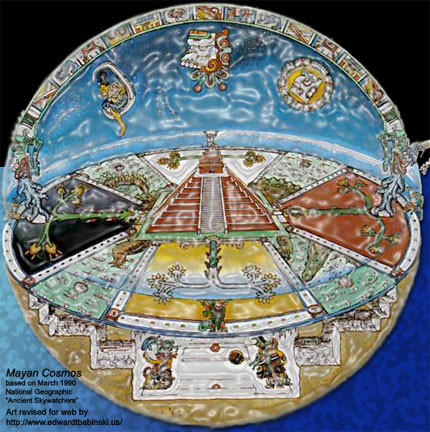
More importantly, what the church fathers believed is not as important as what the ancients believed and there is plenty of evidence that ancient Near Eastern civilizations believed the earth was flat, based on their writings and carved pictures of the cosmos. The flat earth view was undeniably prominent in both Babylon and Egypt during the time when the Old Testament was written. Even during the intertestamental period, between the Old and New Testaments, Jewish literature like the Book of Enoch, spoke unmistakably of the shape of the earth as flat. The New Testament writers from the Gospels to Rev. also seem to take for granted the flatness of the earth. So whatever the “early church fathers” believed, such a question is not of major importance since they lived in a period that came AFTER the Old Testament, the Intertestamental period, or the New Testament, which were “flat-earth” thinking periods of Biblical composition. — E.T.B.)
Sources that argue that the early church taught that the earth was flat:The Flat Earth: A Detailed Study of Historical Flat-Earth Thinking… and the effort to cover it up (Ethical Atheist)
Scientific Creationism, Geocentricity, and the Flat Earth (Robert J. Schadewald)
The Flat-Earth Bible (Robert J. Schadewald)
The Flat-Earth Belief of Bible Writers (Adrian Swindler)
The Flat Earth and its Advocates: A List of References (Science Reading Room) Sources that argue that only a very small number of church fathers taught that the earth was flat
Who invented the flat Earth? (Answers in Genesis)
Creationism and The Early Church (Robert I Bradshaw)
The Myth of the Flat Earth (Bedeʼs Library)
The Flat Earth Pre-Lab (Oklahoma Baptist University)
Jeffrey Burton Russell, Inventing the Flat Earth: Columbus and Modern Historians. New York: Praeger, 1997. 177 pp. Pbk. ISBN: 027595904X. Christian Response To: The Flat-Earth Bible (Sam Shamoun)
Did Bible writers believe the earth was flat? (Paul S. Taylor)
The Scriptural Basis for a Geocentric Cosmology © 1992-2003 by Glenn Elert